
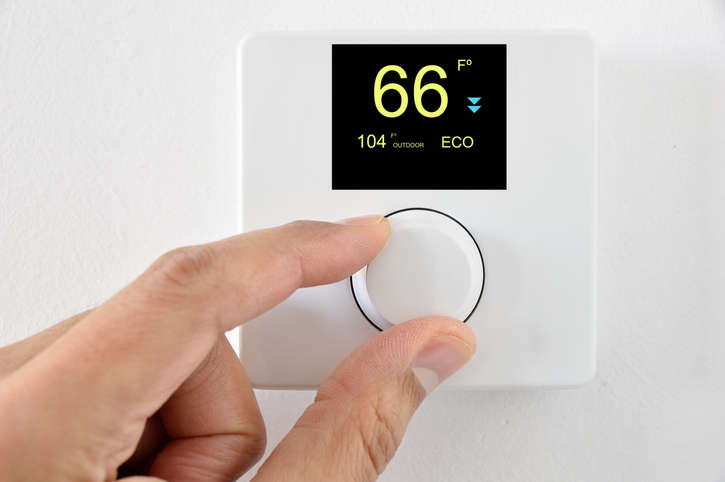
Sleep Hygiene and Thermostats
If you’ve been up at 3 a.m. and cycled through Netflix 50 or 60 times without picking anything and finally wound up googling “why can’t I sleep?” you’ve likely come across a host of good advice regarding your sleep hygiene, most of which pertains to sleep routines but often omits an important factor: room temperature. Studies have shown that even more than light, cooling temperatures are directly tied to quality and depth of sleep.
Daytime temperatures may vary based on personal preferences and the preferences of anyone else living in your home, but 65 degrees is considered an ideal sleep temperature for most people. This may also vary a few degrees up or down depending on blankets, personal internal temperature, and other factors like the severity of any given day of a Chicago winter, but this is the generally accepted starting temperature. Good sleep hygiene means sleeping longer, sleeping more soundly, and waking up less frequently. Multiple studies have tied quality of sleep to mental acuity, happiness, and long-term healthy outcomes.
For the furnace owner, this means getting familiar with your thermostat.
From the classic “turn the dial on the wall” gold knob thermostat to the newest sensor-based wireless systems that can fine tune each living area in a home, the thermostat is truly the control center of your HVAC system. Most existing wired thermostats are programmable by day and time and allow you to drop the overall home temperature at night and bring it up again in the morning. The drawback of these thermostats is that the entire system’s temperature is determined by the location of the thermostat. So, while your living room might be set to 65 degrees, your bedroom is cooler. Take that into account during the programming phase. Older wireless thermostats, which have now been around for more than a decade, allow you the customize the location of the thermostat since no wiring is needed, but still lock the system into a generalized temperature setting. The newest thermostats paired with modern, efficient systems make it incredibly easy to maintain a consistent temperature throughout every nook and cranny of your home – including during sleep hours. These systems operate with motion and temperature sensors throughout the house and can tailor delivery of heat to specific spaces. For instance, if one room tends to be cooler than others at night, the systems can deliver heat to that room alone to bring it up to 65 degrees. Some of these also offer geofencing and other “setback” features, which will automatically turn the system’s temperature down when your wireless device (typically a phone) leaves a pre-determined radius around your home, saving you energy while you’re away.
Setback can be a mildly controversial topic: You may have heard that it takes more energy to raise a home back to temperature than it does to simply maintain a steady temperature. But the benefits of setback don’t arise in a static-temperature environment – they are tied to the constantly fluctuating world outside your home. During the long Chicago winters, your house is losing heat to the outside at a rate determined by a number of factors related to insulation, outside temperatures, etc. Your furnace runs to replace that heat. Over the course of an 8-hour night of sleep, if you drop your temperate to 65 degrees from 72 degrees, during each hour you are saving about 7% in fuel costs (1% per degree per hour). And while it does take some additional energy to re-heat the house to 72 degrees in the morning, it is not significant enough to replace the 7% accrued over 8 hours of sleep the previous night. And, as we have learned, that setback has further health benefits beyond fuel savings.
With temperature covered, it is important to note other factors that contribute to a good night’s sleep. Keeping to a regular sleep schedule is important. While modern sensor-based thermostat systems may adapt to your movement to determine whether to heat a space, it’s still important to stick to a general routine and schedule for your body. Caffeine before bed or late in the day can hinder sleep patterns, as well as nicotine or alcohol. In addition to being cool, the sleeping area should be dark and quiet. If you live in a loud area or building, running a fan or using a white noise machine can help to drown out background sounds. Reading can help settle your mind, but experts advise putting down electronic devices about 30 minutes before bed. Routines and preferences will vary, naturally, but sticking to a routine that works can truly improve your sleep hygiene.
And one other tip for the thermostat user: About 50% of programmable thermostats are never programmed. Take that extra five minutes to dial it in.